
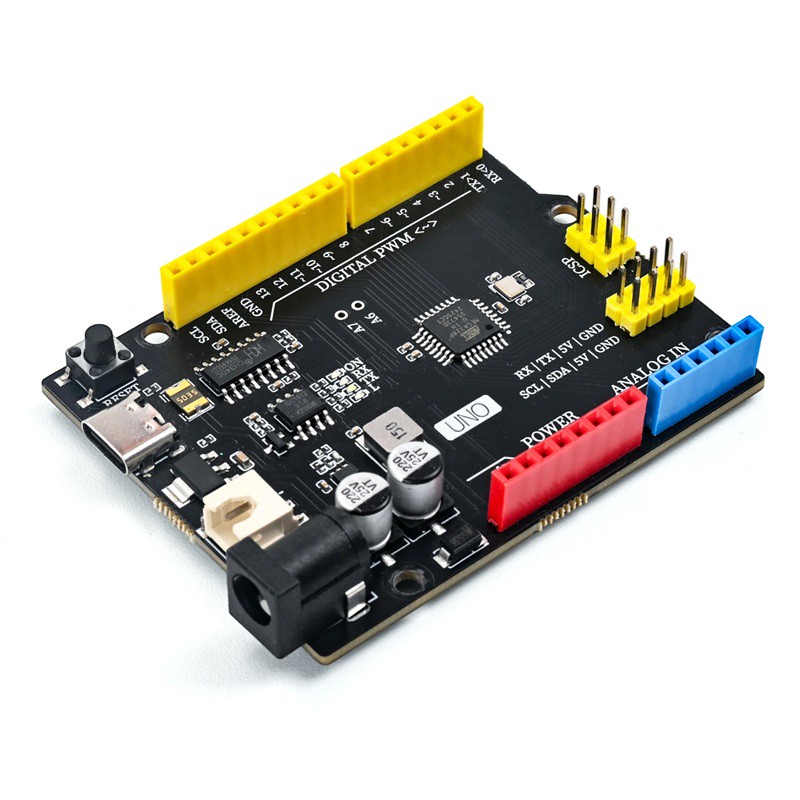
1. Introduction
HELLO-STEM-UNO-R3 (PE) is a compatible Arduino UNO R3 ATmega328P development board, upgrading the traditional USB-B toType-C interface; CH340K implements USB to serial port; TPS54302DDCR implements wide voltage VIN input step-down 5V; AMS1117-3.3 LDO outputs 3.3V;Supports Type-C USB power supply, external VIN DC power supply; the board-mounted P-MOS tube FDN340P serves as a load switch;Built-in multi-color status LED; Retain standard UNO-R3 pin headers while adding WT-2.54-2P CN1 expansion terminals;For maker education, prototype development of analog signal acquisition, single-chip microcontroller experimental projects.
2, Technical Specifications
Main Control MCU | ATMEGA328P-AU |
|---|---|
Flash | 32KB (Bootloader occupies 0.5KB) |
SRAM | 2KB |
EEPROM | 1KB |
System Clock | 16 MHz SMD crystal oscillator |
Main Control Working Voltage | 5V; IO voltage resistance 5V |
Digital IO | D0-D13, a total of 14 channels; D3/D5/D6/D9/D10/D11 support PWM; single IO maximum 20mA sink / source current |
Analog input | A0-A7, a total of 8 ADC channels, 10-bit resolution; A6/A7 are only analog inputs and cannot be used as digital IO |
Onboard operational amplifier | LM358 dual op-amp SOP-8; single power supply 3-30V |
Communication interface | UART(D0-D1), I2C(A4-A5), SPI(D11/D12/D13) |
USB to serial port | CH340K |
5V step-down chip | TPS54302DDCR; input 4.5-28V, output 5V, continuous 3A; 400kHz synchronous Buck, built-in soft start, snore overcurrent protection, thermal shutdown |
3.3V voltage regulation | AMS1117-3.3, maximum output 800mA |
Power supply input | Type-C 5V; VIN DC 6-9V external DC input;Do not connect external power and lithium battery at the same time |
⚠️ Important warning: ATMEGA328P IO is 5V level; when connected to a battery, only connect to2 series lithium batteries (nominal 7.4V)Do not accept orders for battery packs 3.7V and above 3 series lithium batteries; When connecting external 3.3V peripherals, attention must be paid to level matching; When VIN is used as an external power input, it is recommended to use 6-9V for long-term use; CN1 is a 2.54mm pitch 2Pin expansion terminal, pay attention to the positive and negative poles of the power supply when using it, and do not short-circuit;Prohibit simultaneous connection of external power and lithium batteries to the VIN interface.
3, Features
1. Main controller: ATMEGA328P-AU, 16MHz SMD crystal oscillator, 32KB Flash (bootloader occupies 0.5KB), 2KB SRAM, 1KB EEPROM.
2. USB interface: Type-C, CH340K USB-UART bridge, for program download and serial communication.
3. Power supply mode: Type-C USB5V; VIN external DC 6-9V input.
4. Power output: TPS54302DDCR output 5V; AMS1117-3.3 output 3.3V.
5. Onboard operational amplifier: LM358 dual operational amplifier SOP-8, can be used for signal amplification, voltage following, and compatible with weak analog signal collection teaching experiments.
6. IO Resources: 14 digital IO (6 PWM channels), 8 analog inputs A0-A7; UART/I2C/SPI hardware peripherals.
7. Peripherals: Reset button, power, TX/RX, D13 user LED, ICSP programming interface,VUSB/VBAT power toggle switch.
8. Supports compatible standard Arduino UNO R3 expansion board.
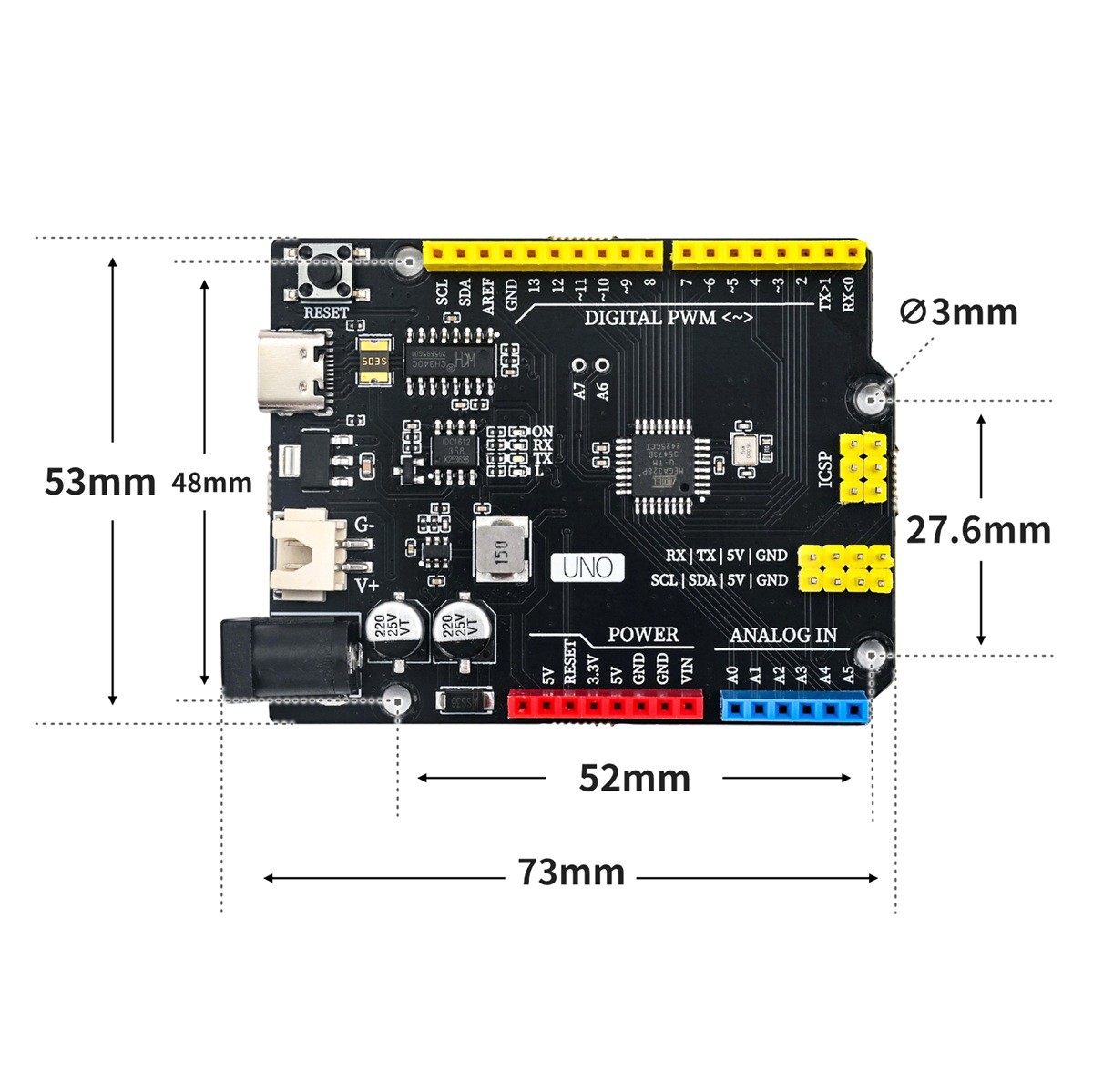
4, Circuit Board Size
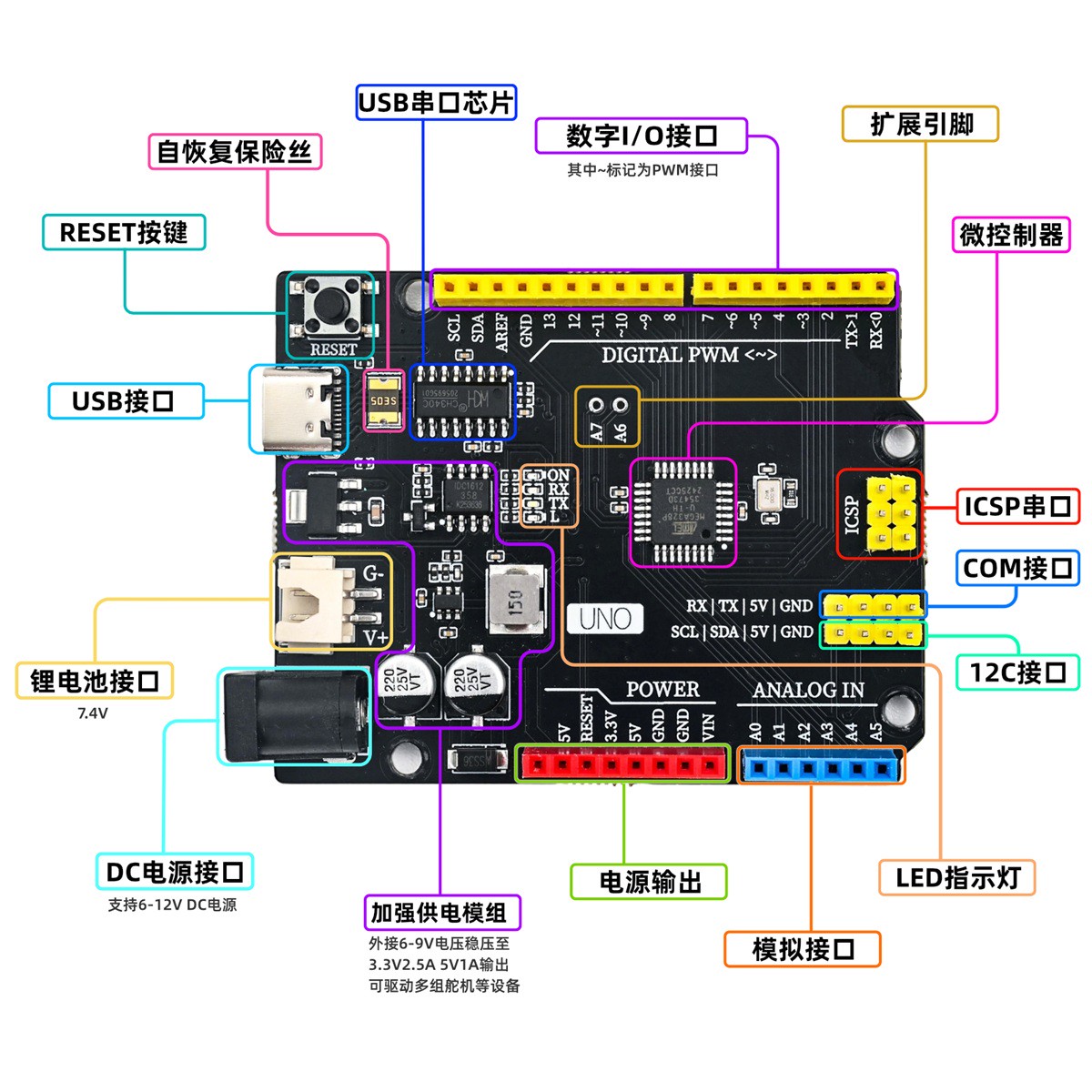
5, Development board decoding
Notice
ATMEGA328P IO is 5V level; external 3.3V devices must be properly level-matched; do not directly input 3.3V signals into 5V IO.
VIN input voltage must not exceed 18V, it is recommended to be ≤6-9V when used as an external power input for a long time.
Avoid connecting Type-C USB and VIN high-voltage simultaneously to prevent reverse power supply from damaging the device.
LM358 operates on a single power supply; input signals cannot be negative; output amplitude is limited, with a maximum output of about 3.5-4V when powered by 5V.
TPS54302DDCR Maximum continuous output 3A; AMS1117-3.3 Maximum output 800mA, note that the total load current should not exceed the rated value.
CN1 (WT-2.54-2P) Extension terminal, strictly differentiate between positive and negative poles when connecting external devices, short-circuiting is prohibited.
After the board-mounted self-recovery fuse MF-MSMF050-2 operates, it needs to be de-energized and cooled for several seconds before it can recover.