1. Introduction
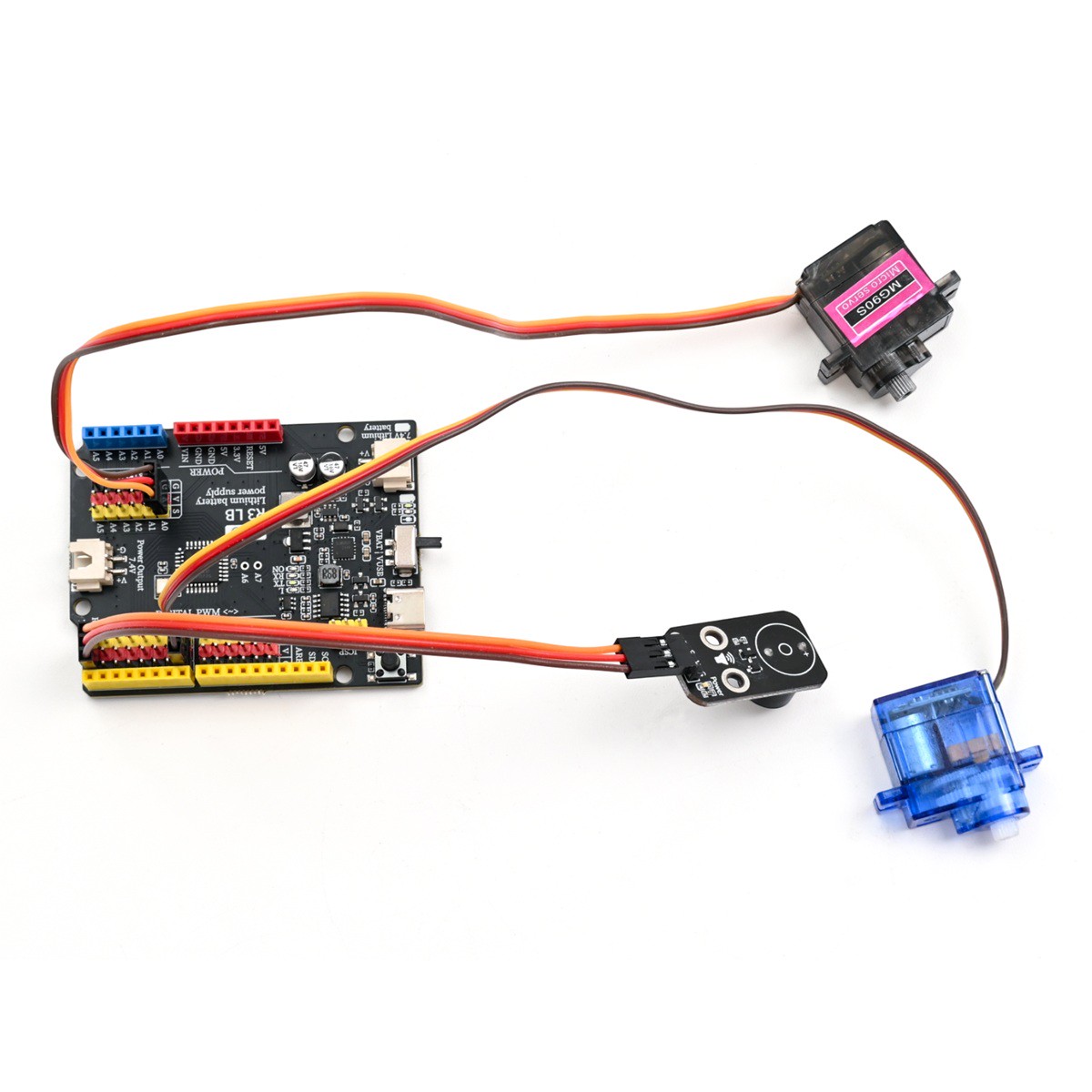
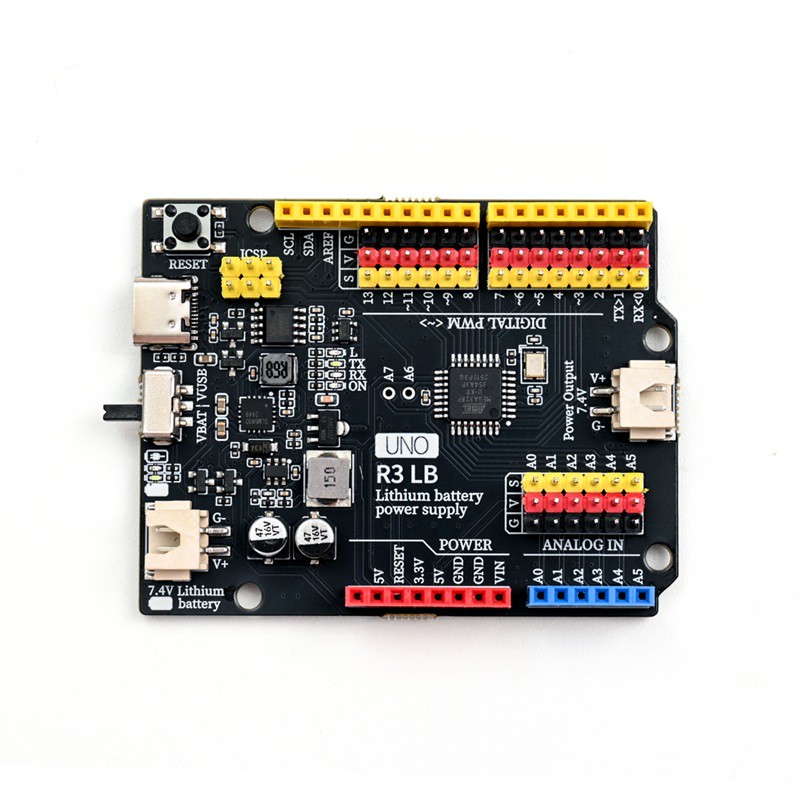
HELLO-STEM-UNO-R3-LB is a compatible Arduino UNO R3 ATmega328P development board, upgrading the traditional USB-B toType-C interface;CH340K implements USB to serial port;TPS54302DDCR implements wide voltage VIN input voltage reduction 5V;SLM6800 as a dual-cell lithium battery boost charging management chip, supporting 7.4V (2S) lithium battery charging and discharging; VIN interface is reused, it can be used as a 7.4V lithium battery interface or as an external DC power input port, and can be connected to external VIN power when no battery is connected;Supports USB power supply, external VIN DC power supply, and 7.4V two-cell lithium battery power supply in three power supply modes; toggle switch to manually switch between VUSB and VBAT power supply; 100% compatible with UNO R3 expansion boards, for maker education, portable prototype development, and microcontroller experimental projects.
2, Technical Specifications
Main Control MCU | ATMEGA328P-AU |
|---|---|
Flash | 32KB (Bootloader occupies 0.5KB) |
SRAM | 2KB |
EEPROM | 1KB |
System Clock | 16 MHz ceramic resonator |
Main Control Working Voltage | 5V; IO voltage withstand 5V; peripherals 3.3V |
Digital IO | D0-D13, a total of 14 channels; D3/D5/D6/D9/D10/D11 support PWM; single IO maximum 20mA sink / source current |
Analog input | A0-A7, a total of 8 ADC channels, 10-bit resolution |
Communication interface | UART(D0-D1), I2C(A4-A5), SPI(D11/D12/D13) |
USB to serial port | CH340K |
5V step-down chip | TPS54302DDCR; Input 4.5-28V, output 5V, continuous 3A; 400kHz synchronous Buck, built-in protection; Enabled by toggle switch |
Lithium battery charging chip | SLM6800;5V input step-up charge 2S lithium battery (nominal 7.4V, fully charged 8.4V); Maximum charging current 1A; Switching frequency 750kHz; Charging voltage accuracy ±1%; Overcharge, short-circuit, over-temperature protection |
3.3V voltage regulation | AMS1117-3.3, maximum output 800mA |
Power supply input | Type-C 5V; VIN multiplex interface: Can accept 6-9V DC external power, or can accept 7.4V (2 series lithium polymer, fully charged 8.4V) lithium battery;Do not connect external power and lithium battery at the same time |
Power switching device | Toggle switch, choose one: VUSB power / VBAT power, simultaneously controlling TPS54302DDCR enable and system 5V power path |
⚠️Important: VIN is a multiplex interface, when connected to the battery, only the connection is allowed2 series lithium batteries (nominal 7.4V)Prohibit single battery 3.7V and 3 series or more lithium batteries; It is recommended to use 6-9V for long-term use when VIN is used as an external power input;Prohibit simultaneous connection of external power and lithium batteries to the VIN interface.
3, Features
1. Main controller: ATMEGA328P-AU, 16MHz external ceramic resonator
2. USB interface: Type-C, CH340K USB-UART bridge, for program download and serial communication.
3. Power supply mode: Type-C USB5V; VIN interface reuse: External DC 6-9V input / 7.4V (2S) lithium battery connection; use a toggle switch to manually switch between VUSB/VBAT power supply.
4. Power output: TPS54302DDCR output 5V; AMS1117-3.3 output 3.3V.
5. Battery management: SLM6800, 5V input step-up to charge 2S lithium battery, cutoff at full charge 8.4V, maximum charging current 1A.
6. IO Resources: 14 digital IO (6 PWM channels), 8 analog inputs A0-A7; UART/I2C/SPI hardware peripherals.
7. Peripherals: Reset button, power, TX/RX, D13 user LED, ICSP programming interface,VUSB/VBAT power toggle switch.
8. Fully compatible with standard Arduino UNO R3 expansion board.
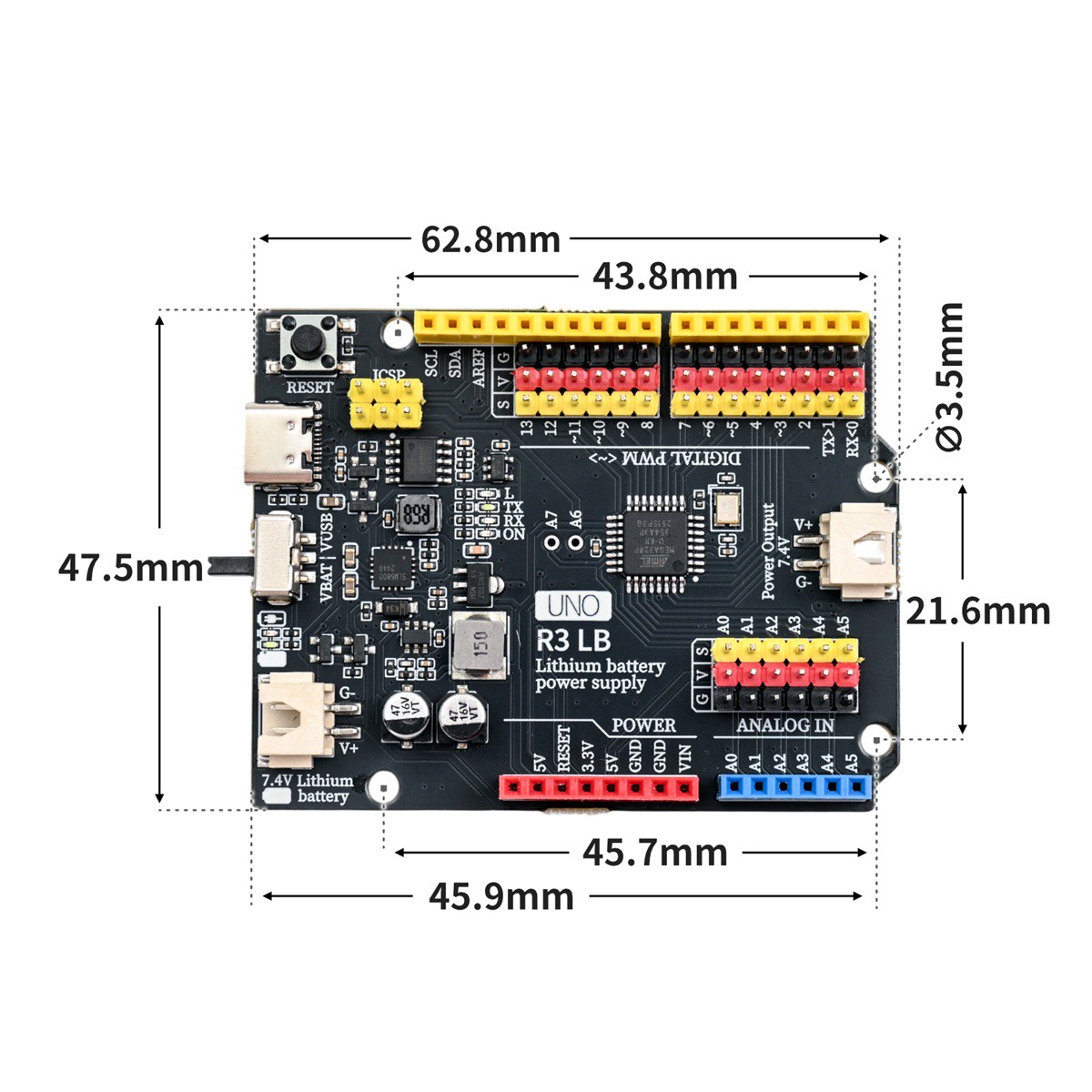
4, Circuit Board Size
5, Development board decoding
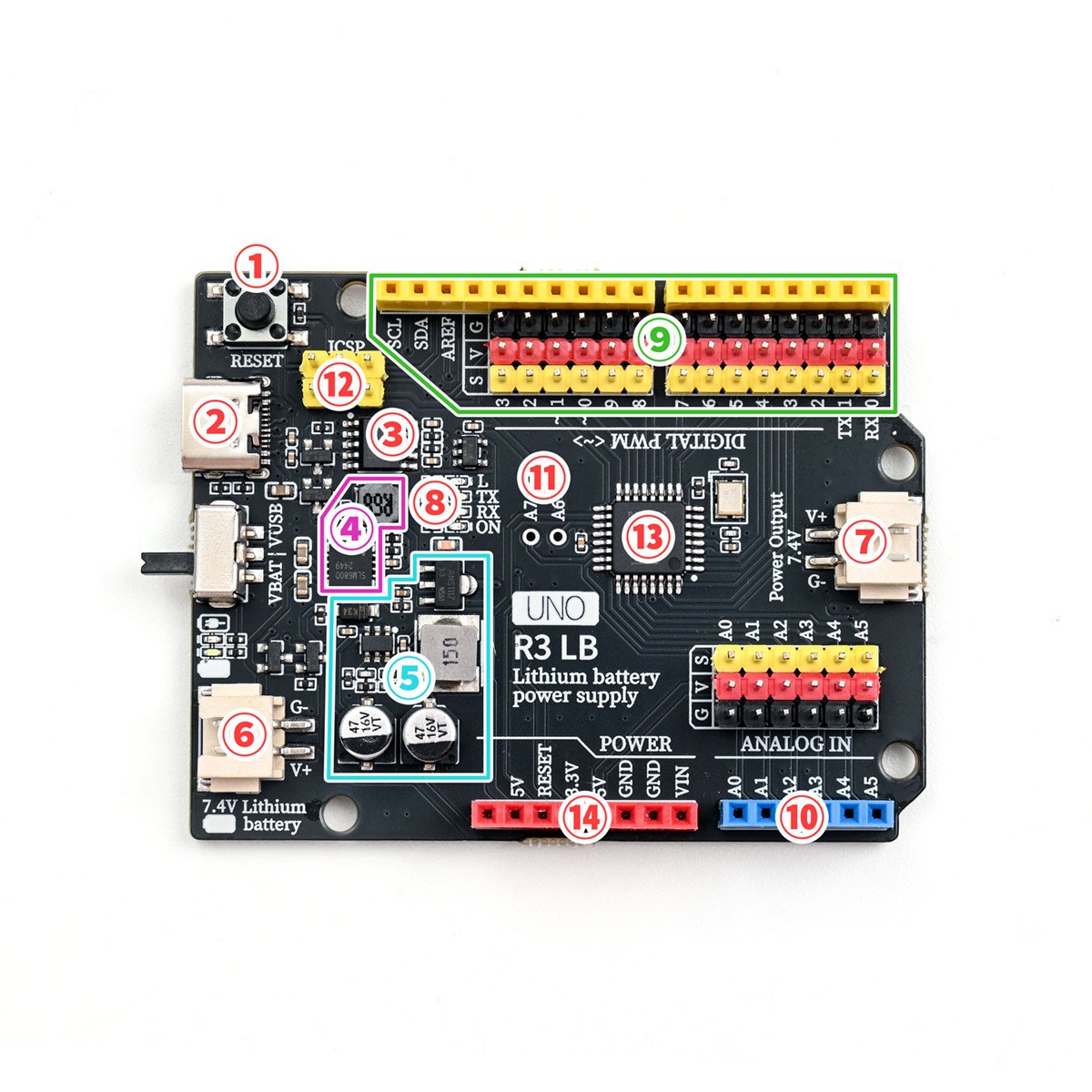
① Reset button
Press the reset button, the development board will restart and run the recorded program again.② Type-C interface (USB interface)
It can supply power to the development board via computer USB and also undertake the functions of program download and serial communication data transmission.③ Serial port chip
Responsible for converting the data received from the Type-C USB into serial data and transmitting it to the ATMEGA328P main control chip.④ Charging IC module
Lithium battery charging management chip, when the Type-C is connected to the power supply, it can charge the 7.4V lithium battery connected to the battery interface.⑤ Enhanced power supply-stabilization circuit
High-power voltage regulation module, stabilizing the 7.4V lithium battery voltage to output 5V high current, capable of driving multi-channel servos, motors and other high-power peripherals.⑥ Battery Interface
Special lithium battery socket, supporting connection of 7.4V (2 in series 18650) lithium battery power supply, suitable for mobile projects such as cars and robotic arms.⑦ Power Output Terminal (Right Side)
Independent power output interface, capable of outputting 7.4V battery voltage to power external high-power equipment.⑧ LED Indicator Light
On-board multi-color indicator lights: the power indicator light is always on; the RX/TX serial port light blinks when data is received and transmitted; the L light corresponds to the D13 pin level status.9th digital I/O interface (digital G/V/S expansion port)
Digital pin expansion terminals, G=GND negative pole, V=5V positive power pole, S = digital signal pin. Some pins are marked with PWM, supporting servo, LED dimming and other analog output functions.10th analog interface (analog G/V/S expansion port)
Basic analog signal input pins A0-A5, used to read the voltage signals of analog sensors such as potentiometers, light sensors, etc.⑪ A6 A7 analog port
Reserved pad expansion for additional analog input channels, which can accommodate more analog sensors⑫ ICSP serial port
ICSP program burning interface, which can be used with a downloader to burn Bootloader firmware to the main control chip.⑬ Microcontroller (ATMEGA328P main control chip)
The core brain of the development board, responsible for storing programs, executing code, performing calculations, and controlling the signal input and output of all IO pins.Power output
This terminal can output 5V, 3.3V, VIN original power voltage, and ground wire.
Notice
1.IO pin maximum sink/source current is 20mA, high-power peripherals must be driven by external circuits (MOS, transistor, relay module).
A6, A7 only support analog input and cannot be used as digital IO.
SLM6800 only compatible2 in series 7.4V lithium battery (fully charged 8.4V).Prohibition of single battery or 3 in series lithium battery connection, otherwise battery overcharge fire and chip burnout.
VIN input voltage must not exceed 18V, it is recommended to be ≤6-9V when used as an external power input for a long time.
When connecting a lithium battery to VIN, it is strictly necessary to distinguish between V+(B+), G-(B-), and reverse connection will directly damage the SLM6800.
Toggle switch function: VUSB position off TPS54302DDCR, USB directly supplies 5V power to the mainboard; VBAT position on TPS54302DDCR, 5V is output to the mainboard by TPS54302DDCR, cutting off USB power supply to the mainboard, USB retains data and charging input functions.
The switch is in the VBAT position, the VIN interface has no valid power, only insert Type-C, the mainboard will not start, Type-C only performs charging and data communication.
VIN is a multiplexed interface,It is strictly prohibited to connect external DC power and lithium batteries simultaneously to the VIN interface, which will cause hardware damage.
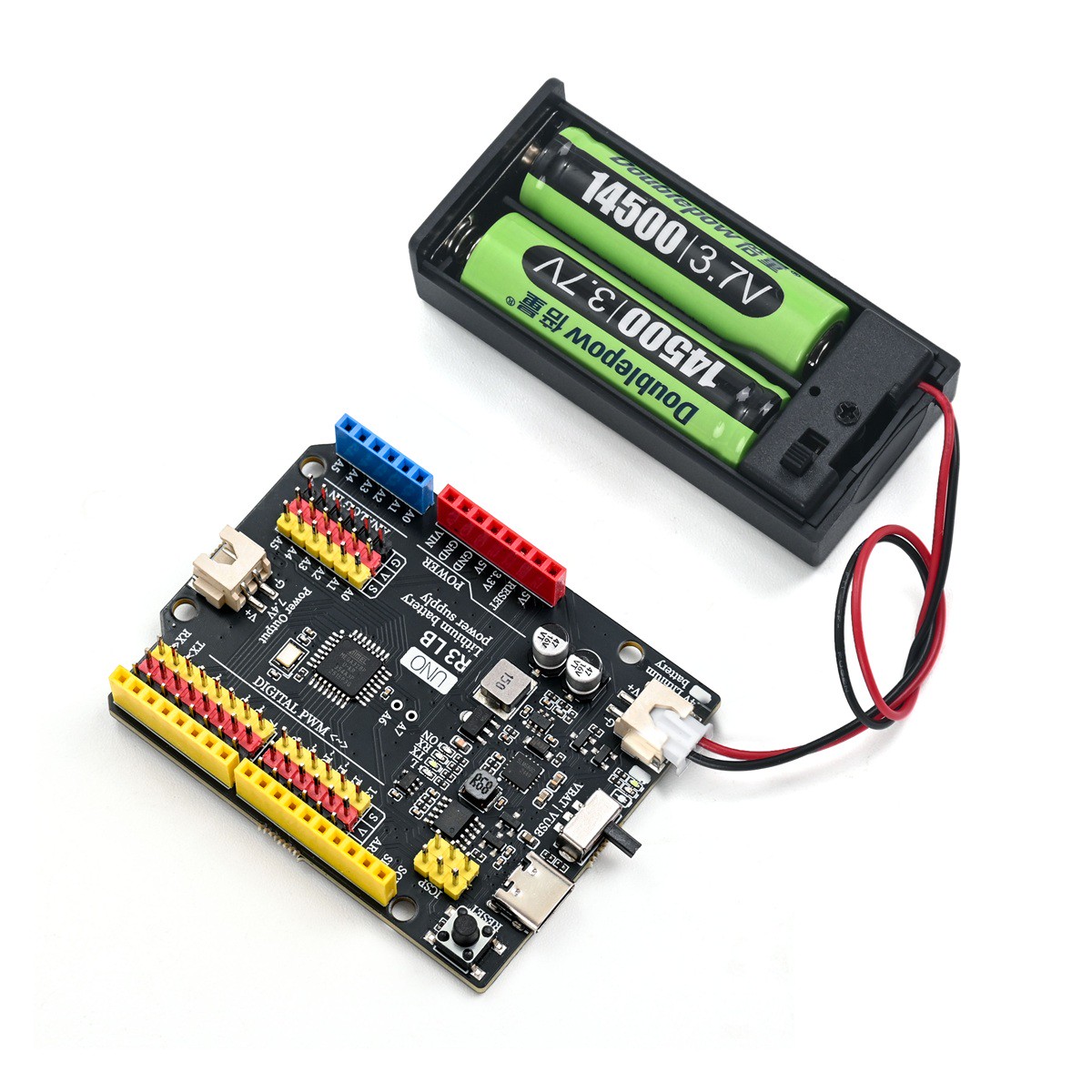
6. Special Lithium Battery Interface
Special battery interface, can connect 14500 lithium batteries or 18650 lithium batteries, making it easier to layout when creating mobile projects.
7, sensor and expansion accessories interface
The on-board digital G|V|S interface is more convenient and quick to connect sensors or actuators, and no expansion board is needed when building projects.